
Office
Sapporo TV Tower
An observation tower completed in 1957 at the eastern end of Odori Park in central Sapporo. Standing 147 meters, it was engineered by Naitō Tachū and registered as a Tangible Cultural Property in 2025.
An observation tower completed in 1957 at the eastern end of Odori Park in central Sapporo. Standing 147 meters, it was engineered by Naitō Tachū and registered as a Tangible Cultural Property in 2025.

A 30-story, 133-meter office tower completed in 1982 in West Shinjuku, developed jointly by Nippon Life Insurance and Sumitomo Realty. Its full-height atrium stretching from ground to roof is its defining feature.

Completed in November 1996 through a major urban redevelopment project in Sangenjaya, Setagaya Ward, Carrot Tower rises 27 floors and 124 meters above street level. The mixed-use complex anchored by the Setagaya Public Theatre (1,300 seats) integrates commercial, office, and observation facilities, serving as a transit hub for the Tokyu Den-en-toshi and Setagaya lines.

Completed on March 3, 2011 and opened the following day — one day before the full opening of the Kyushu Shinkansen — JR Hakata City replaced the old Hakata Station building with a 10-floor, 60-meter mixed-use complex. At approximately 199,085 m², it is about seven times the size of its predecessor and remains the largest station commercial facility in Kyushu.

Opened on September 4, 1994 on an artificial island in Osaka Bay, the Kansai International Airport passenger terminal stretches 1,672 meters in length with a total floor area of 303,943 m². Designed by Renzo Piano and a Japanese consortium, it was the world's first airport built entirely on a man-made island and pioneered hydraulic jack systems to counter the island's ongoing settlement.

Completed in 2006 and opened in January 2007, the National Art Center in Roppongi is Japan's largest national art museum with a total floor area of 49,834 m². Designed by Kisho Kurokawa and Nihon Sekkei, its undulating glass curtain wall and cone-shaped interior structures make it one of Tokyo's most distinctive cultural buildings.

Completed in May 2012 at 1-1-1 Marunouchi, Chiyoda Ward, Palace Hotel Tokyo stands 23 floors and approximately 114 meters tall, directly adjacent to the Imperial Palace Outer Garden. Designed by Mitsubishi Jisho Sekkei, the 290-room luxury hotel replaced the original 1961 building by Yoshiro Taniguchi and offers unobstructed views of the palace's green canopy.
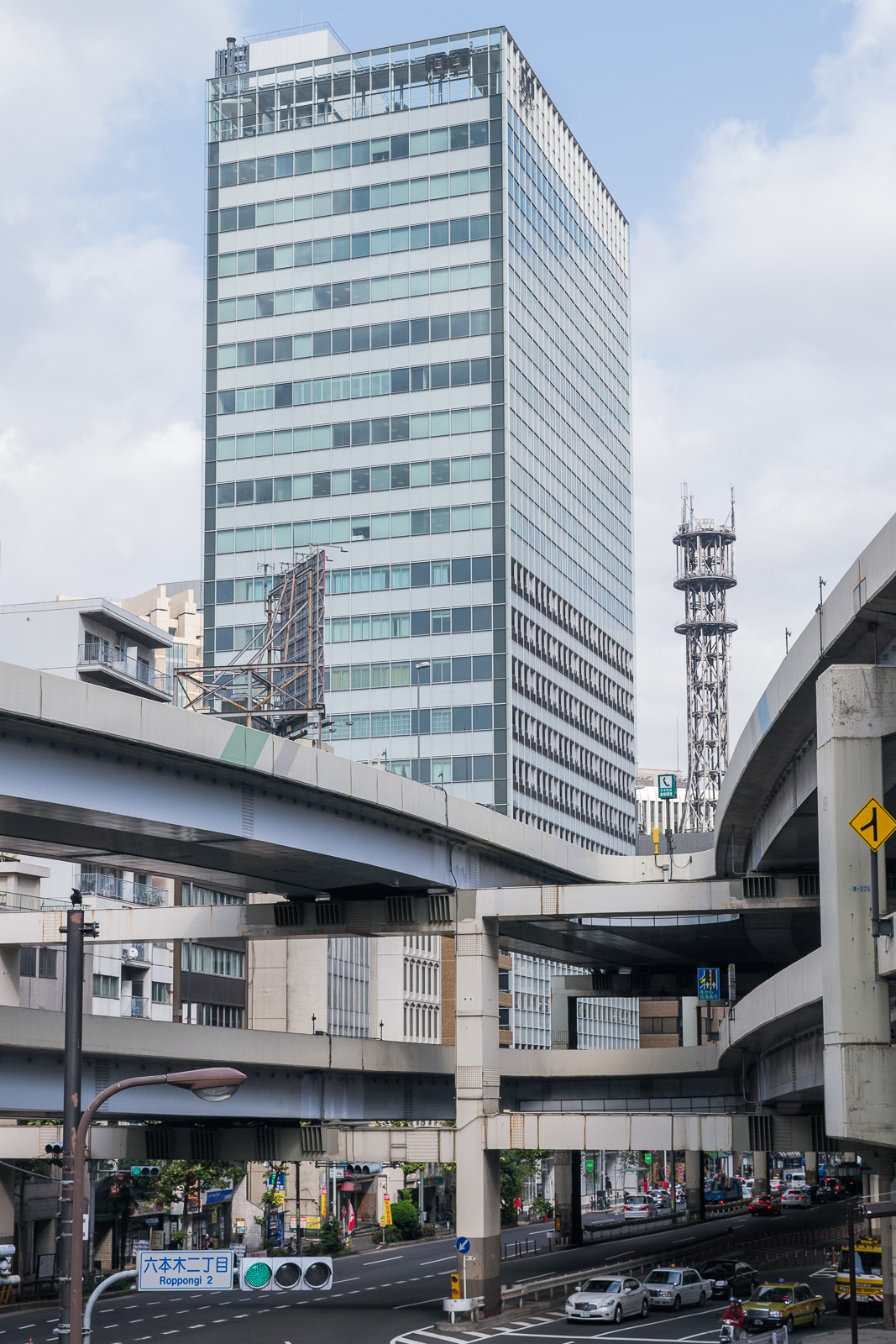
A 22-story mixed-use tower completed in 2011 in Akasaka, Minato City. Developed by Mori Building as part of its ARK Hills cluster, it stacks offices, residences, and retail on a hillside site midway between Roppongi-itchome and Akasaka stations.

A 24-story office tower completed in January 2014 on the south side of Osaki Station's west exit. The centerpiece of the Osaki Wiz City block, it was developed alongside a residential tower, retail, and a welfare facility through an urban redevelopment project.

A two-tower complex completed in 2000 at Shibuya Station's west exit. The East tower rises 25 floors to nearly 100 metres and includes a hotel; the West tower holds 23 floors of offices. The Keio Inokashira Line station and a major bus terminal are woven directly into the building.