Transport
Lines, stations, terminals and airports — the transport infrastructure that moves people and goods across Tokyo and the Kanto region.

Tsukuba Express Akihabara – Tsukuba Metropolitan Intercity Railway's line between Akihabara and Tsukuba, opened 24 August 2005. The 58.3-kilometre, 20-station route runs at up to 130 km/h, covering the distance in as little as 45 minutes. Built alongside a 3,300-hectare land-readjustment programme along its corridor, the line is one of Japan's closest examples of railway-led urban development.

Chuo Line Rapid Tokyo to Takao The orange-vermilion commuter line linking Tokyo Station and Takao over 53.1 kilometres. Tracing its origins to the Kobu Railway of 1889, it runs from the central business district out to the suburbs of the Tama area, and is known for one of the longest straight stretches on Tokyo's rail network.

Tokyo Monorail Hamamatsucho to Haneda Airport Japan's first airport railway, opened on 17 September 1964 — twenty-three days before the Tokyo Olympics. The straddle-beam ALWEG-system monorail runs 17.8 km across 11 stations from Monorail Hamamatsucho to Haneda Airport Terminal 2, now operated as a wholly owned subsidiary of JR East.

Yurikamome Shimbashi to Toyosu (Waterfront) An automated guideway transit line that opened between Shimbashi and Ariake in November 1995, crossing Rainbow Bridge to reach the Tokyo waterfront sub-centre. Extended to Toyosu in March 2006, the line now runs 14.7 km across 16 stations and has grown in step with the development of Odaiba and the Rinkai Fukutoshin.
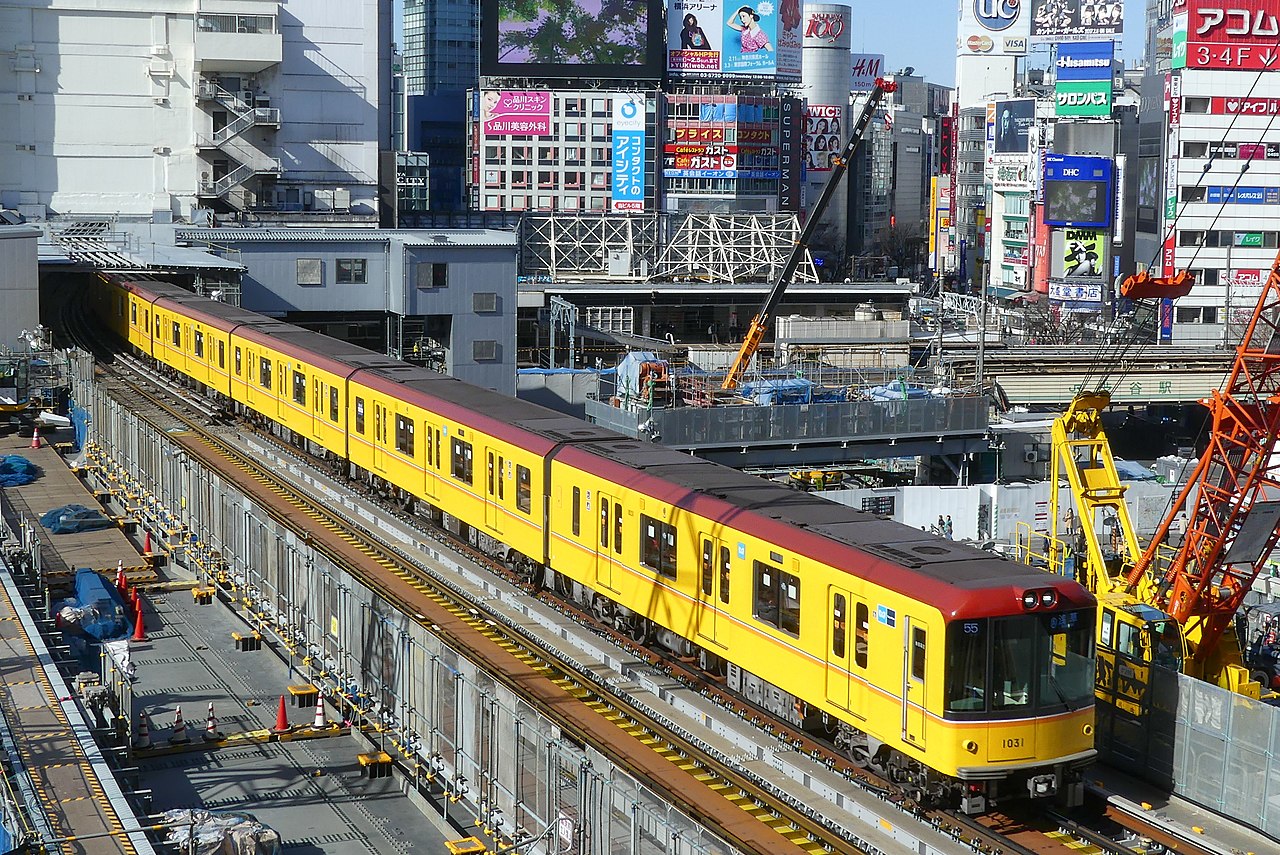
Tokyo Metro Ginza Line Asakusa to Shibuya Asia's first subway, opened on 30 December 1927 between Asakusa and Ueno, now running 14.2 km across 19 stations from Asakusa to Shibuya. The Ginza Line retains its original engineering — third-rail power at 600 V DC and standard-gauge track — largely unchanged since opening.

Yamanote Line Central Tokyo loop A 34.5-kilometre loop connecting 30 of Tokyo's core stations — Shibuya, Shinjuku, Ikebukuro, Ueno, Tokyo, Shinagawa — with a full circuit taking around 64 minutes. The loop service opened in 1925 and has defined the spatial structure of central Tokyo ever since.
Takanawa Gateway Station / Takanawa Gateway City Minato City Opened in March 2020 as a new stop on the Yamanote and Keihin-Tohoku lines, Takanawa Gateway Station features a dramatic origami-inspired roof designed by Kengo Kuma. It anchors the Takanawa Gateway City redevelopment — a 9.5-hectare project on a former JR depot site transforming the gap between Shinagawa and Tamachi.
Ueno Station Taito City Opened in 1883 and the main gateway to northeastern Japan for over a century, Ueno Station holds 22 platforms across three distinct levels — elevated, ground-level, and underground. Its dead-end ground-floor platforms, a legacy of the Ueno hillside hemming in the site, carry the quiet memory of all the terminus trains that once terminated here.

Shibuya Station Redevelopment Shibuya City Opened in 1885, Shibuya Station serves four operators across nine lines. Its bowl-shaped valley terrain — with platforms stacked across 30-plus metres of elevation — makes the ongoing reconstruction one of the most complex urban rail projects in Japan. Full completion is targeted for fiscal 2034.

Shinjuku Station Shinjuku City Opened in 1885, Shinjuku Station is served by five operators across 36 platforms and holds Guinness World Records certification as the world's busiest railway terminal. The Shinjuku Grand Terminal plan — anchored by a 48-storey tower and an east–west pedestrian deck — is under construction with the tower due in fiscal 2029.
Page 3 of 4